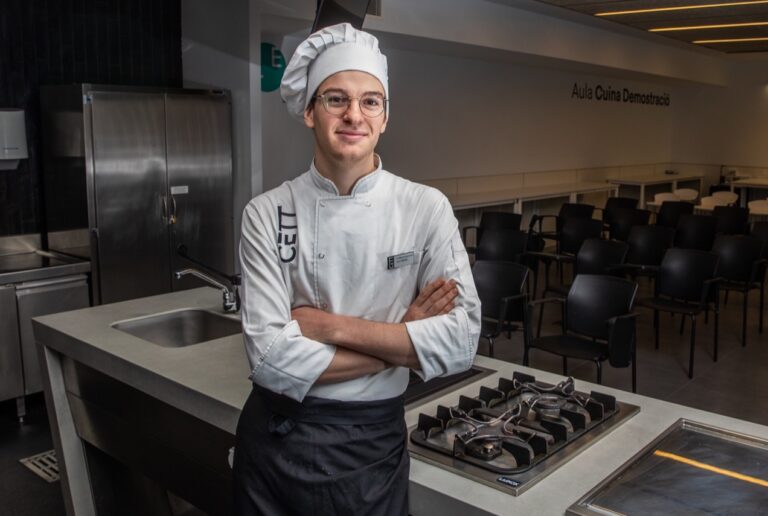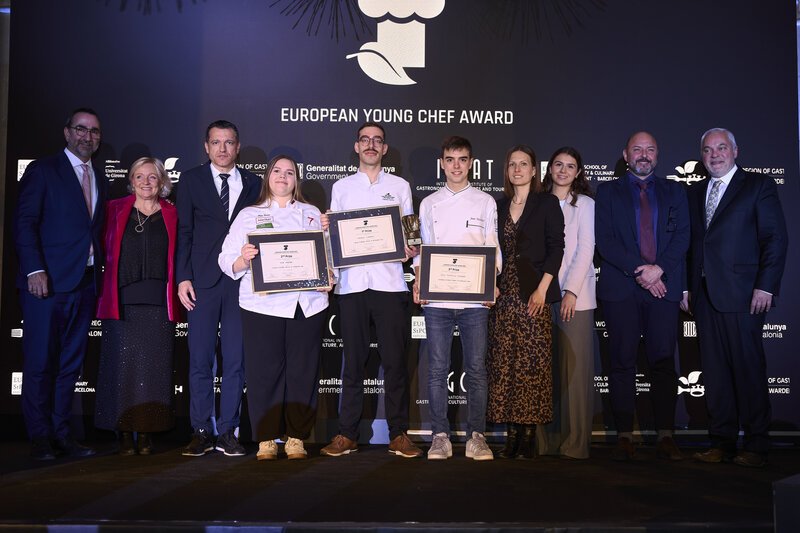
Ioannis Liapakis from Crete European Region of Gastronomy 2026 was awarded European Young Chef for 2025 on 27 November. With the dish Erevinthos, Ioannis impressed the international jury, chaired by Xavier Pellicer – a leading figure in plant-based fine dining, from Catalonia, World Region of Gastronomy awarded 2025.
A Dish Rooted in Cretan Heritage
The jury unanimously awarded Ioannis first prize. They praised the dish for its depth of flavour and its strong connection to Cretan heritage. They highlighted how Ioannis elevated a humble, symbolic recipe while honouring values of resilience, resourcefulness and respect for the land.
The jury also commended all finalists for their dedication to sustainability and their support for local producers. Thanks to the high calibre of entries, each finalist represented their region with excellence.
Nine Finalists from Across Europe
The competition took place at Sant Pol School of Hospitality and Culinary Management in Sant Pol de Mar (Catalonia) from 24–27 November 2025. Finalists represented nine awarded and candidate European Regions of Gastronomy:
- Pija Frešer (Slovenia awarded 2021)
- Joana Gonçalves (Coimbra awarded 2021 – Portugal)
- Joan Taltavull Juaneda (Menorca awarded 2022 – Spain)
- Gabriele Somma (Sicily awarded 2025 – Italy)
- Ànakin Rivera Vázquez (Catalonia awarded 2025 – Spain)
- Ioannis Liapakis (Crete awarded 2026 – Greece)
- Nigel Frank Tabone (Gozo awarded 2026 – Malta)
- Ivan Barčot (Central Dalmatia candidate 2027 – Croatia)
- Bogdan-Andrei Lovin (Banat candidate 2028 – Romania)
Second and Third Prize Winners
Pija Frešer from Slovenia earned second prize with United Kingdom of Pohorje Pisker. The jury celebrated the dish as a vibrant and authentic reflection of Pohorje. They noted how it preserved the flavours of the traditional stew while adding a refined, contemporary touch.
Joan Taltavull Juaneda from Menorca took third prize with Arròs de la Terra, a dish centred on xeixa wheat. The jury praised his skill in elevating a nearly lost local grain.
Innovation on Tradition
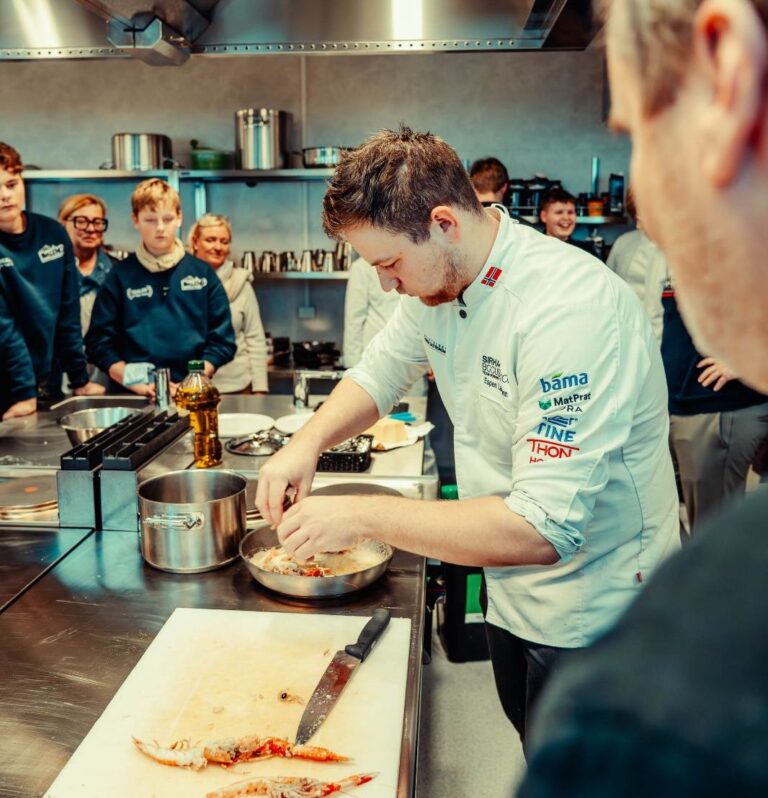
On 25 November, finalists presented traditional dishes and shared knowledge about local ingredients from their regions. They competed on 26 November, offering innovative interpretations of these recipes while using the same local products.
This format encouraged learning, cultural exchange and professional networking. It also reinforced the importance of culinary innovation, sustainability and local produce in traditional cuisine.
The International Jury
An international jury of chefs and experts evaluated the finalists’ dishes. The panel was chaired by chef Xavier Pellicer, Executive Chef of Xavier Pellicer Restaurant. He was awarded “Best Vegetable Restaurant of the World” in 2018 and 2019 by the We’re Smart Green Guide and received the National Gastronomy Award in 2024.
The jury also included:
- Frida Jensen (Denmark), pastry chef and owner of Façon by Frida
- Ken Trahv (Estonia), chef and founder of several hospitality brands
- Evi Chioti (Cyprus), Executive Chef, Culinary Consultant and Certified Judge
- Per T. Tørrissen (Norway), IGCAT Expert and Manager of the Northern Norway Competence Center for Food
- Wendy Barrie (Scotland), IGCAT Expert, cook, writer and Director of the Scottish Food Guide and Scottish Cheese Trail
Evaluation Criteria
Besides technical skill, the judges assessed creativity, storytelling, food-waste reduction and the responsible use of meat, fish and vegetables. They also evaluated the finalists’ knowledge of local products and producers.
Award Ceremony at the University of Barcelona
The award ceremony took place on 27 November at the historical building of the University of Barcelona. Attendees included:
- Òscar Ordeig, Minister of Agriculture, Livestock, Fisheries and Food of Catalonia
- Dèlia Perpiñà, Director of PRODECA
- Arantxa Calvera, Director of the Catalan Tourist Board
Ministerial Remarks
Òscar Ordeig stated:
“Catalonia has been proud to contribute to such an important World celebration of gastronomy. I want to congratulate all the finalists and young chefs — you are the future of our culinary heritage. Above all, we celebrate our local food producers: without their work, dedication and passion, there would be no gastronomic heritage to honour.”
IGCAT President’s Address
Dr Diane Dodd, President of IGCAT, thanked the hosts for offering an exceptional culinary journey through Catalonia. She addressed the finalists with heartfelt appreciation:
“You are the new guardians of our culinary traditions. Over these past days, you have demonstrated extraordinary creativity, sensitivity and a deep understanding of why our food and cultural heritage must be cherished and shared.”
Event Hosts
The ceremony was hosted by Núria Soler, who also moderated the livestream together with Dr Dodd and Marta Minoves, Winner of the European Young Chef Award 2024.
Commitment to Sustainability and Local Products
On 25 November, all finalists signed up as IGCAT Regional Chef Ambassadors, committing to promote their regions’ food and cultural heritage sustainably throughout their future careers.
Throughout the programme, the finalists also explored Catalonia’s gastronomy, visiting producers and learning about local food systems.
About IGCAT’s European Young Chef Award
The European Young Chef Award is an annual competition organised by the International Institute of Gastronomy, Culture, Art and Tourism (IGCAT). It brings together young culinary talents from the awarded and candidate European Regions of Gastronomy.
Finalists qualify through local contests. They compete by innovating traditional regional recipes while using local ingredients, thus maintaining cultural identity and promoting sustainability.
The 9th edition of the European Young Chef Award is organised and promoted by the International Institute of Gastronomy, Culture, Art and Tourism (IGCAT) and hosted by Catalonia, World Region of Gastronomy awarded 2025 at Sant Pol School of Hospitality and Culinary Management.
The European Young Chef Award 2025 is hosted by the Government of Catalonia and supported by EUHT St Pol.
About the World & European Regions of Gastronomy
The World Regions of Gastronomy and the European Regions of Gastronomy, guided by IGCAT, work together to:
- strengthen food security through the celebration of distinctive food cultures;
- create employment by stimulating creativity and gastronomic innovation;
- nourish children and adults through culinary and cultural education;
- driving environmental sustainability in tourism, hospitality and agricultural sectors;
- supporting balance and sustainable tourism practices;
- highlighting and supporting expertise from within rural and urban communities, creating connections and sharing good practices;
- contributing to community health and well-being.
About IGCAT
IGCAT empowers local communities by raising awareness of the need to protect and promote regional food, culture, arts and natural assets. This work supports sustainable and balanced tourism and development strategies, which are essential to safeguarding the planet, health, wellness and local economies.
Founded in 2012, IGCAT is a non-profit institute that collaborates with regional stakeholder consortiums in gastronomy, culture, arts and tourism. The Institute relies on a global network of experts and works in partnership with specialised intergovernmental organisations.
IGCAT serves as the official secretariat for the World Region of Gastronomy and the European Regions of Gastronomy Platforms. The Institute has also developed the European Young Chef Award, the World Food Gift Challenge, the Top Foodie Websites Award and the international Food Film Menu.